AI CRM Security:
Zoho’s Privacy-First Approach vs. OpenAI
Your sales team is probably already using AI CRM —whether your company has approved it or not.
Client names, budgets, contracts, deal notes, medical records, financial data—employees paste this information into ChatGPT day to save time.
Most companies have no AI policy, no audit trail, and no idea where that data ends up.
This is precisely why many regulated businesses prefer AI built directly into the CRM rather than routing customer data through external AI .
We explain the real risks of using AI CRM , including data privacy, AI , customer data security, and what businesses should know before sharing sales data with ChatGPT other AI .
CRM in AI: The Hidden Risk
Before discussing risks, there’s a fundamental distinction worth making—one that most people completely overlook.
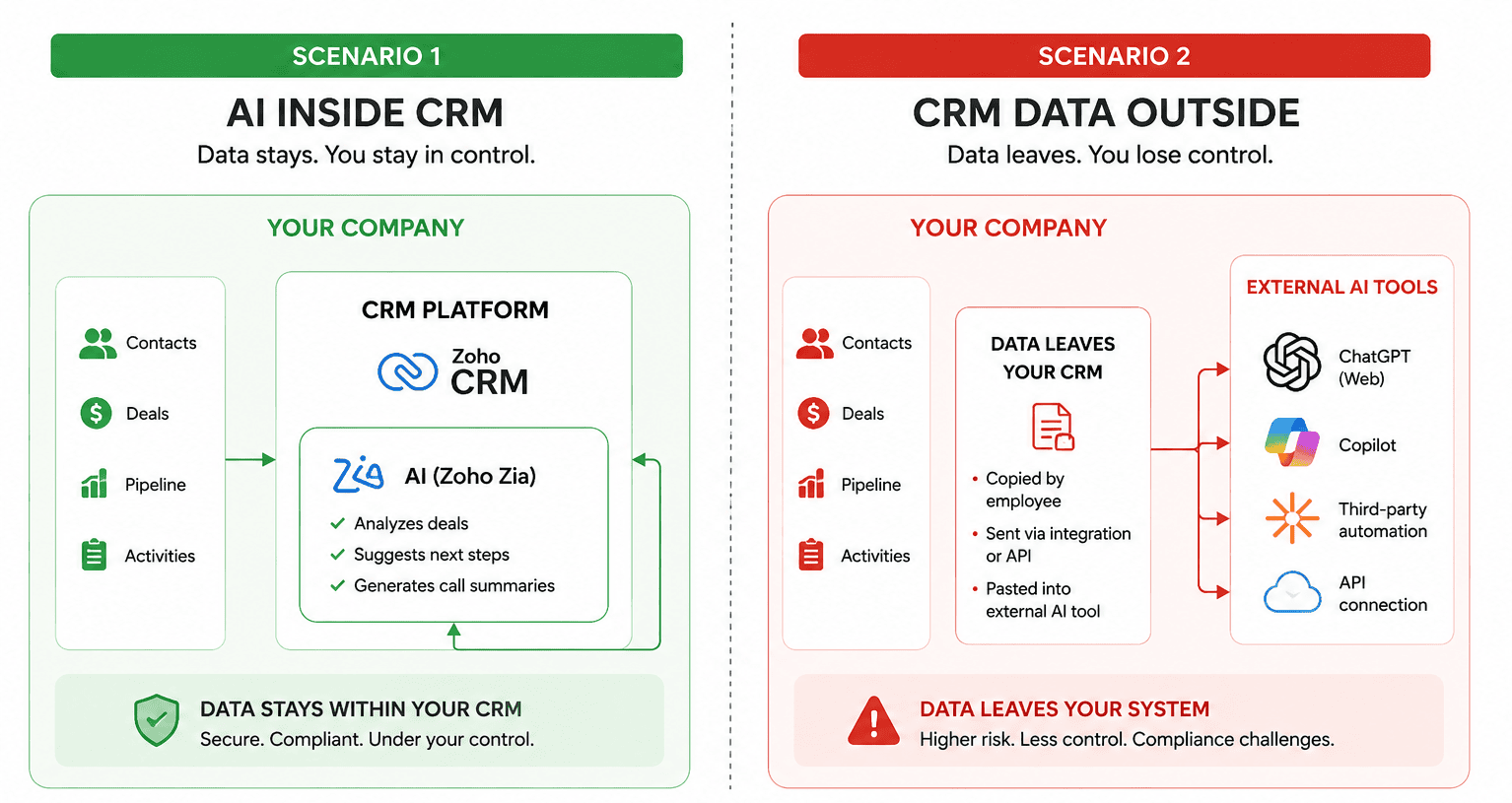
Scenario one. AI integrated into your CRM and operates within it. Zoho Zia, for example, analyzes your deals, suggests next steps in the sales process, or generates call summaries directly within the CRM . Your data never leaves the platform—it’s processed right where it’s stored.
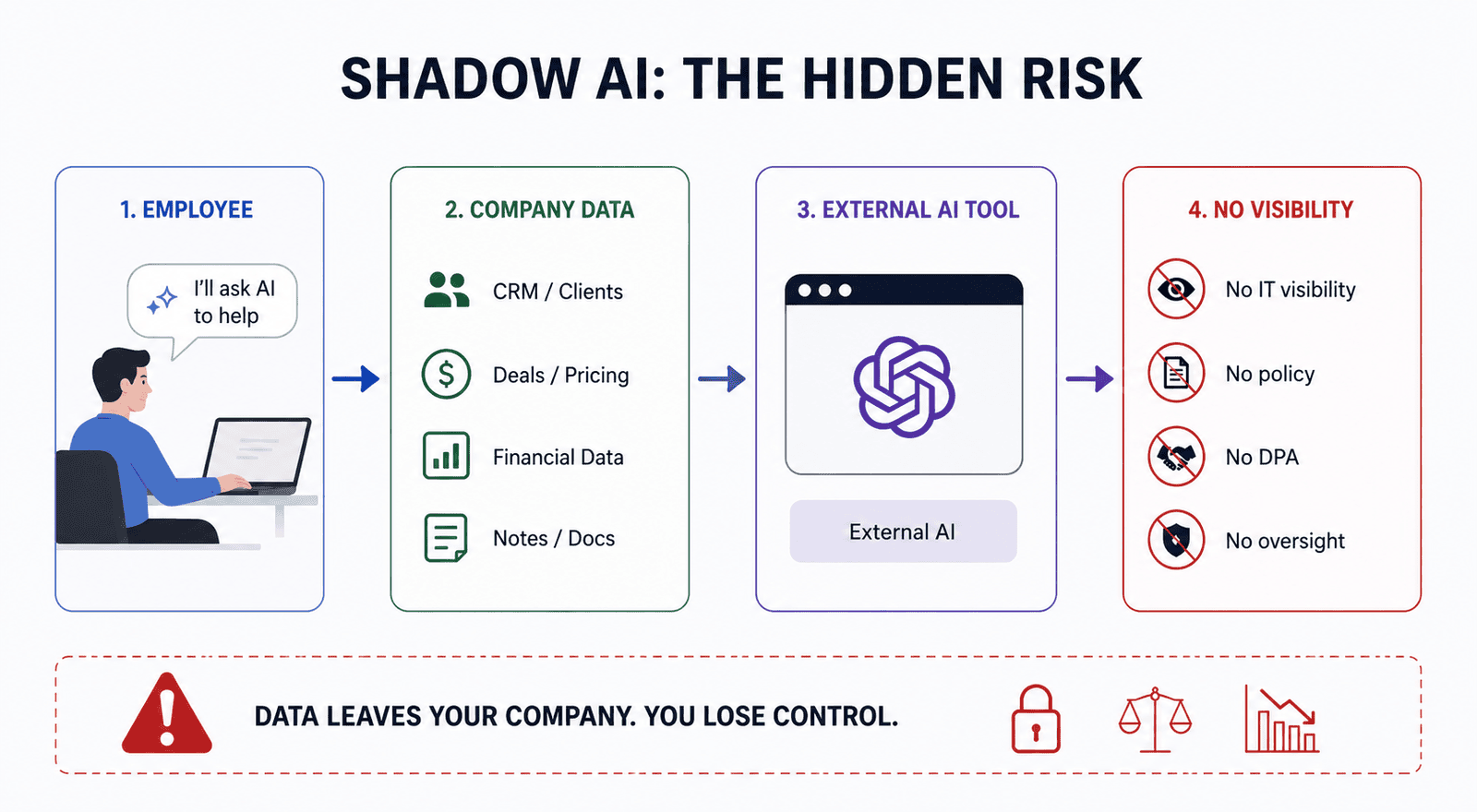
Scenario two. Someone on your team extracts data from the CRM sends it to an external AI either manually or through an integration. This could be ChatGPT a browser, a Copilot plugin, a third-party automation tool, or an API . In this case, the data physically leaves your system and enters another vendor’s infrastructure.
Both approaches are common. Both produce results. But the second approach carries fundamentally different risks in terms of security, compliance, and control.
The most common form of scenario two is what is known as "shadow AI": employees using external AI on their own—without official company approval, without IT oversight, and without any policy governing what data is acceptable to share. Studies suggest that anywhere from 40 to 60 percent of office workers do this regularly. Most of their companies are unaware of this, and have no rules in place.
What "Privacy-First" Actually Means — and Why It Matters
Zoho is one of the clearest examples of what the industry refers to as a privacy-first approach. But to avoid this sounding like a marketing slogan, let's look at what it means in practice.
A business model without advertising. Most large technology platforms monetize user data through advertising—either directly or indirectly. Zoho built a different model from the start: the company generates revenue exclusively from subscriptions. That means there is no financial incentive to collect more data than the product needs to function.
This matters because incentives shape behavior. A company that sells advertising wants to collect as much data about users as possible. A company that sells a SaaS is only motivated to ensure the product works well.
Data minimization. A privacy-first approach means collecting only what is genuinely necessary for the feature to function—not "just in case," not "we might use it someday." Only what the tool actually needs to do its job.
User control. Zoho’s position is clear: customer data belongs to the customer. The company does not claim any rights to use it beyond the provision of the service. This is reflected in their Privacy Policy and in the Data Processing Agreement (DPA) available to enterprise customers.
Data residency. For companies where the physical location of data storage is critical—especially in light of GDPR local regulatory requirements—Zoho offers data center options across multiple regions. European companies can keep their data within EU infrastructure,
for many organizations.
AI remains within the platform. Zoho Zia and other AI within Zoho CRM data within Zoho's own infrastructure. Your pipeline, deals, and contacts are not sent to third-party systems to generate responses.
7 Signs Your Company Already Has a Shadow AI
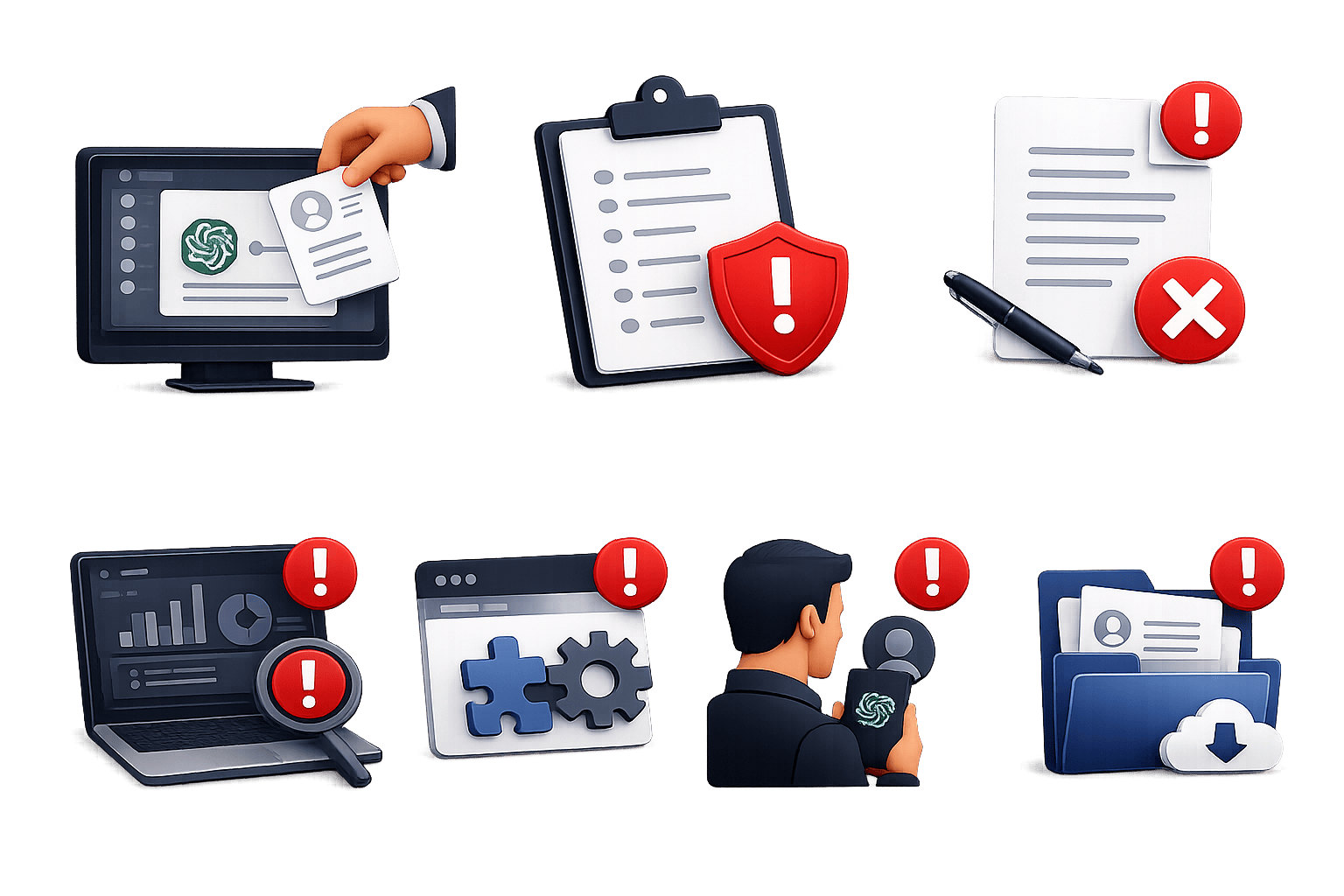
Employees paste CRM into ChatGPT
No written AI policy
No DPA agreements with AI
No audit logs
Unknown browser plugins
Sales reps use personal AI
No restrictions on CRM : create an image but without text
Want AI Your CRM Without Losing Control Over Customer Data?
OpenAI the AI Approach: Capabilities and Key Considerations
OpenAI a different approach. The focus here is on the raw power of generative AI GPT-4 and newer models deliver a level of text generation, analysis, and synthesis that currently has no close equivalent in terms of the breadth of its applications.
That is precisely why OpenAI API —or simply ChatGPT the browser—have become so widespread in corporate settings. It’s fast, accessible, and delivers immediate results.
But there are a few things you should understand before routing business data through it.
ChatGPT web) and the API to different terms. When employees use ChatGPT a free or Plus in a browser, OpenAI , by default, use those conversations to improve its models. This feature can be turned off in the settings—but it is enabled by default, and most users are unaware of this.
The API differently. When you access OpenAI API OpenAI API , by default, they do not train models on the data you submit. However, this only applies to direct API . If you are using a third-party tool that runs on OpenAI the scenes, the terms depend on how that tool is configured—which may or may not include the same safeguards.
Data retention. By default, OpenAI data sent through the API up to 30 days for safety monitoring and abuse detection purposes, after which it is deleted. For ChatGPT, the retention period depends on whether conversation history is enabled.
Internal access. Like any major technology vendor, OpenAI internal teams that may access certain data—for example, to review potential policy violations. This is standard practice across the industry, but it’s important to keep this in mind when sharing confidential business information through the system.
Enterprise plan. OpenAI Enterprise terms that include stronger privacy guarantees, no model training on customer data, and the option to sign a DPA. If your company is seriously considering OpenAI business use, the Enterprise plan is where a meaningful discussion about data security truly begins.
The point isn't that OpenAI an unsafe option or a bad company. The point is that capability and data control are distinct considerations—and the trade-off between them is something every business needs to evaluate carefully rather than by default.
Real Risks: What Can Actually Go Wrong
Let's get specific. These are the scenarios where the lack of a clear AI creates real problems.
B2B SaaS Agencies
A sales manager is preparing a proposal for a corporate client. They paste the deal details into ChatGPT budget, technical requirements, decision-makers' names, and timeline. In seconds, they receive a well-organized proposal.
The problem: this data is likely subject to an NDA, or is at the very least competitively sensitive. If a competitor were to gain access to similar information, they would learn about your pricing structure, your clients, and your pipeline. The risk isn’t hypothetical—it depends on how the data is processed and stored on the other end.
Healthcare
A medical clinic uses AI automatically generate visit summaries or handle support chat responses. If those requests include patient data—even without names, just symptoms plus ID—this may constitute a HIPAA in the U.S. or a GDPR in Europe. Regulators do not accept "we didn't realize" as a defense.
Fintech
An analyst feeds financial transaction data or KYC records into AI pattern analysis. This data is subject to strict regulatory oversight. The question isn't just whether the AI it—it's whether your vendor has the certifications and signed agreements required to handle such information in the first place.
E-commerce
Customer personal data: email addresses, shipping addresses, order history. Under GDPR, your business is the data controller. If you transfer this data to an external AI a proper data processing agreement (DPA) in place with that vendor, you are in violation—regardless of whether any data was actually "leaked."
Shadow AI The Most Common Risk
All of the above scenarios can come to pass not through official integrations, but through the routine daily activities of individual employees. A sales representative, an analyst, a support agent—any of them may be feeding business data into external AI every day without even realizing that data governance is an issue.
Until a company establishes clear rules, this situation continues unchecked.
Compliance: GDPR, HIPAA, and What They Actually Require
If your business operates in the EU or works with customers based in the EU, GDPR to you regardless of where your company is headquartered.
The key points to understand when it comes to AI:
You remain the data controller. Even when you transfer data to an external AI , you remain responsible for how it is processed. The AI acts as a data processor—and you are required to have a signed Data Processing Agreement in place with them.
A DPA isn't just a formality. It must specify: what data is being processed, for what purpose, how long it is retained, who has access, how data breaches are handled, and where the servers are physically located. If a vendor cannot or will not sign a DPA—that is a red flag worth taking seriously.
Cross-border data transfers. Under GDPR, transferring personal data about EU citizens to third countries—including the United States—is only permitted under specific conditions. OpenAI, as a U.S. company, has mechanisms in place for this (Standard Contractual Clauses), but their existence must be verified, not simply assumed.
HIPAA. For the U.S. healthcare sector, the requirement is clear: any vendor that processes Protected Health Information (PHI) must sign a Business Associate Agreement (BAA). No BAA, no HIPAA . Period.
Checklist: What to Check Before Implementing Any AI
Regardless of which AI you're evaluating—whether it's built into your CRM an external tool—these are the questions you should ask before connecting it to your business data.
On data storage
Where is the data physically stored (data center location, country)?
How long does the vendor retain data after processing?
Is there a process for requesting deletion?
What happens to the data when the contract ends?
On model training
Is my data used to train AI ?
Can this be disabled—and how, exactly?
Does this apply to all of the vendor's products, or only to specific plans?
On Access and Security
Who within the vendor's organization can access my data?
Under what circumstances can the vendor access my queries or data?
What security certifications does the vendor hold (SOC 2, ISO 27001)?
What is the data breach notification process?
Regarding compliance
Will the vendor sign a Data Processing Agreement?
Do they have GDPR data transfer mechanisms (e.g., Standard Contractual Clauses)?
For healthcare: Will they sign a Business Associate Agreement?
On the specifics of integration
What data is sent to AI each request—and can this be limited?
Is it possible to control which CRM are sent to the AI which aren't?
Are there audit logs showing who sent what data to the AI, and when?
If most of these questions aren't clearly addressed in the vendor's public documentation—or if their support team can't answer them—that's reason enough to pause.
Not sure which AI your team is already using?
CRMOZ companies audit CRM AI , identify data exposure risks, and design compliant AI within Zoho CRM.