The CRM Decision That Will Shape Your Growth
Zoho CRM one of several mid-market platforms—alongside HubSpot, Pipedrive, Freshsales, and Monday CRM that appeal to companies seeking a balance between functionality and cost. But the success of the implementation rarely depends on which platform you choose.
The pattern usually goes like this: a company chooses a CRM, hands the setup to a freelancer, an in-house IT specialist, or the marketing team—and a few months later, the system is only partially in use. Data is scattered across spreadsheets and inboxes, processes aren’t integrated, leads get lost between stages, and leadership has no clear picture of the pipeline or performance. Sound familiar?
This isn't a HubSpot or a Zoho issue. It stems from treating the CRM a technical tool rather than the foundation of a revenue-generating process—regardless of which platform is used.
In this article, we explore different approaches to implementing a CRM —what they actually cost and how they impact results. No platform rankings or vendor evaluations—just a comparison to help you decide which implementation path is the best fit for you.

Option 1: Freelancer
Pros
- Quick start. You can find and hire a freelancer within a few days. If the task is specific and limited in scope, this is a quick and convenient option.
- Flexibility. You pay for a specific amount of work without any long-term commitments. For one-time setups or hypothesis testing, this is a reasonable model.
- Cost. Freelancers typically charge lower hourly rates than agencies. For small businesses or startups with limited budgets, this may be the only realistic option in the early stages.
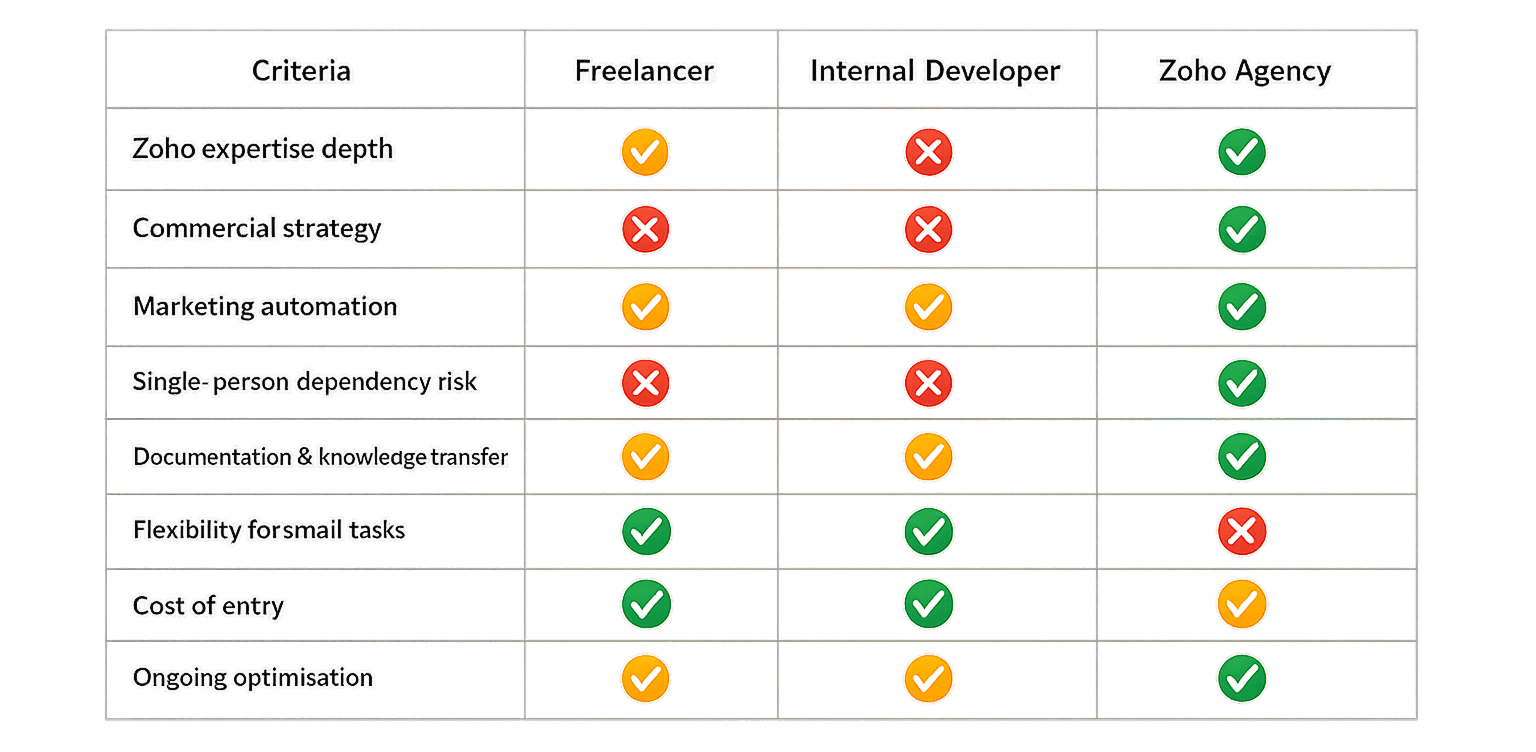
- Specialization. Among freelancers, there are true Zoho experts—people who have completed dozens of implementations and have a deep understanding of the platform. Such specialists can deliver agency-level quality.
Cons
- Lack of business acumen. Most freelancers simply deliver what you ask for—but they don’t help you figure out what you should be asking for. They rarely delve into your sales funnel, business logic, or marketing strategy.
- Limited availability. Good freelancers are usually busy. If your project expands or urgent tasks come up, you may end up on a waiting list.
- Documentation. Freelancers rarely leave detailed documentation. Everything they build can remain a “black box” for your team.
Risks
The main risk is reliance on a single person. If the freelancer becomes unavailable, changes priorities, or simply disappears—you’re left with a system that no one else understands. This is not uncommon.
There is also a risk of a mismatch between expectations and results: without a proper discovery process, it is easy to end up with a system that is technically sound but commercially useless.
Who it's for: Businesses with clearly defined, limited tasks. Or companies that already have in-house CRM and only need specific technical assistance.
Option 2: Developer or IT specialist
Pros
Contextual knowledge. An in-house specialist understands your company, its processes, and its people. No onboarding time is required. Availability. They are right nearby. You can ask questions or request changes at any time without having to coordinate with a third party. Accountability. An internal employee is motivated to ensure the system functions effectively, as this directly impacts their job performance and reputation within the organization. Long-term cost efficiency. If you have someone who can effectively manage CRM part of their responsibilities, this can be cost-effective over time.
Cons
A different mindset. IT specialists are focused on technical accuracy, not business results. The systems they build may be logically flawless but fail to reflect actual sales or marketing behavior. Workload. CRM not a one-time project. It requires ongoing support, optimization, and team training. Adding this to an already busy person’s workload risks compromising quality in both areas. Limited knowledge of the ecosystem. A developer may have a strong CRM understanding of Zoho CRM but lack experience with Zoho Campaigns, SalesIQ, Analytics, and marketing integrations.
Risks
Risk of knowledge concentration. If the entire system “resides in one person’s head,” a single resignation or illness can bring operations to a standstill. Technical debt risk. Without an outside perspective, the system may gradually accumulate workarounds and suboptimal solutions that are difficult to fix later. Delays. What an agency can complete in 6–8 weeks may take an in-house team 6–12 months due to competing priorities.
Who this is for: Companies that already have someone with strong CRM and marketing knowledge, or those ready to hire such a person full-time for this role.

A Expert Agency
This is where the analysis shifts from a cost comparison to growth leverage. AnExpert Zoho Agency is not a vendor. It is a revenue architecture partner.
Pros
The difference is fundamental.
Commercial discovery before technical configuration. Before a single automation is built, CRMOZ your entire revenue funnel—from the initial lead source to closed-won deals to post-sale retention. We understand your sales cycle, your buyer personas, your average deal size, and your current conversion bottlenecks.
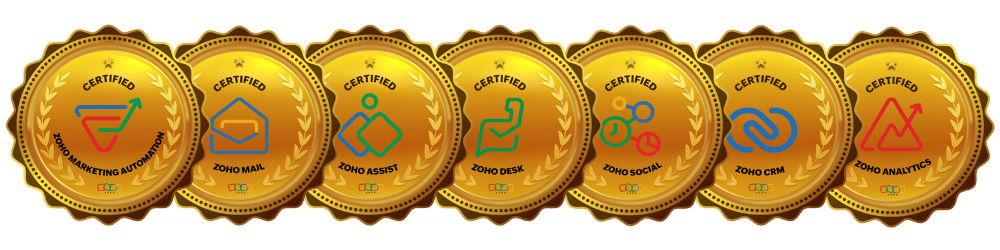
Mastery of the Zoho ecosystem, not just a superficial understanding. Zoho is not just a single product. It is a connected ecosystem of over 45 applications—including CRM, Campaigns, Analytics, SalesIQ, Books, Projects, Desk, and more. CRMOZ advanced certifications and has hands-on implementation experience across the entire suite.
Marketing automation designed for B2B . Most CRM stop at contact management and pipeline stages. CRMOZ automation sequences that nurture leads from first contact to sales-ready—lead scoring, behavioral triggers, multi-channel follow-up, and handoff protocols that your sales team will actually use.
Ongoing optimization with commercial accountability.CRMOZ disappear after go-live. Our retainer model includes monthly performance reviews tied to commercial KPIs: lead velocity, pipeline conversion rates, revenue attribution, and automation performance. We optimize continuously because we are measured on outcomes—not hours.
Cons
Cost. An agency is more expensive than a freelancer. A retainer model involves recurring costs that must be justified by results. Less flexibility for small tasks. Agencies are designed for complex, structured projects. If you need to change a single field or adjust a single automation trigger, the agency model can seem like overkill. Quality varies significantly. Not all agencies are created equal. Some hold Zoho certifications but have limited practical implementation experience. The quality of the discovery process, strategic thinking, and execution can vary substantially from one agency to another.
Risks
Risk of over-reliance. If the agency fails to transfer knowledge or build internal capabilities, you will remain dependent on an external provider. This is not necessarily a bad thing, but it is important to understand this dynamic from the outset. Risk of misaligned priorities and scale. A large agency working with enterprise-level clients may devote less attention to your project than you might expect. It is important to understand where your business fits within their portfolio and how much priority it will realistically receive.
What Is the Actual Cost of a Poor CRM ?
Most companies don’t realize the cost of a poorly implemented Zoho system because it doesn’t appear as a separate line item—it shows up as lost revenue.
Based on industry benchmarks and internal project data:
- Companies lose 10–25% of their potential revenue due to broken or untracked sales processes
- Up to 30% of leads are never properly followed up due to poor automation or gaps in accountability
- Sales teams spend 15–20% of their time working with incomplete or unreliable data
That’s not a tooling issue—it’s a system design problem.
Who it's for
Companies for which CRM a key driver of growth, that want to implement robust marketing automation, and that recognize this as an investment rather than an expense.
Why CRMOZ Specifically
CRMOZ created to address this very issue for B2B that have chosen Zoho and want to maximize its business value. We are both Zoho users and implementation experts.
We are not a generalist agency that picked up Zoho as a secondary skill. We are not a marketplace of freelancers loosely coordinated under a brand. We are a dedicated team of Zoho specialists, marketing automation strategists, and B2B consultants built around one question: How do you turn a Zoho ecosystem into a predictable revenue engine for a growing B2B ?
Our clients include companies in the professional services, technology, healthcare administration, manufacturing, and financial services sectors.
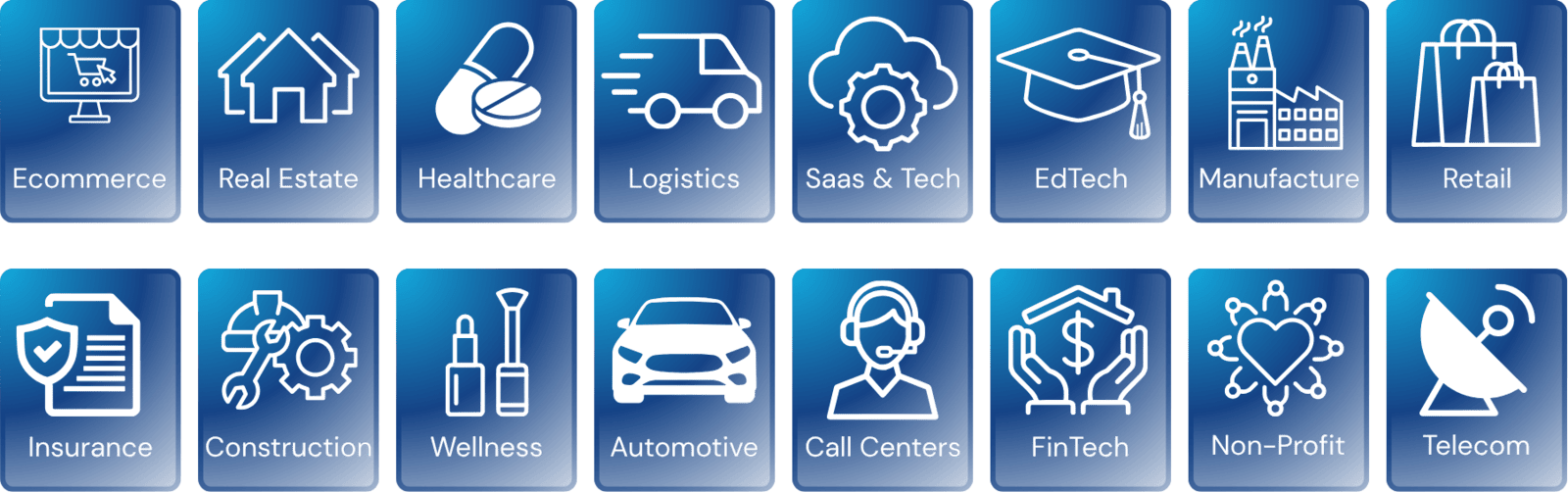
What they have in common: They chose Zoho because they wanted it to drive revenue, and they needed a partner who understood both sides of that equation—the platform and the commercial outcome.
The Honest Decision Framework
Choose CRMOZif you want Zoho to be a true revenue driver—not just a contact database—and you want a partner accountable for business results, not billable hours.