Zoho MCP: Put AI for Your Business
Imagine having a smart assistant that doesn’t just answer questions but actually performs tasks—such as issuing invoices, updating deals in your CRM, creating support tickets, and scheduling meetings. All of this can be done with a single command, without having to click through forms or switch tabs.
What Zoho MCP Means for Business Owners
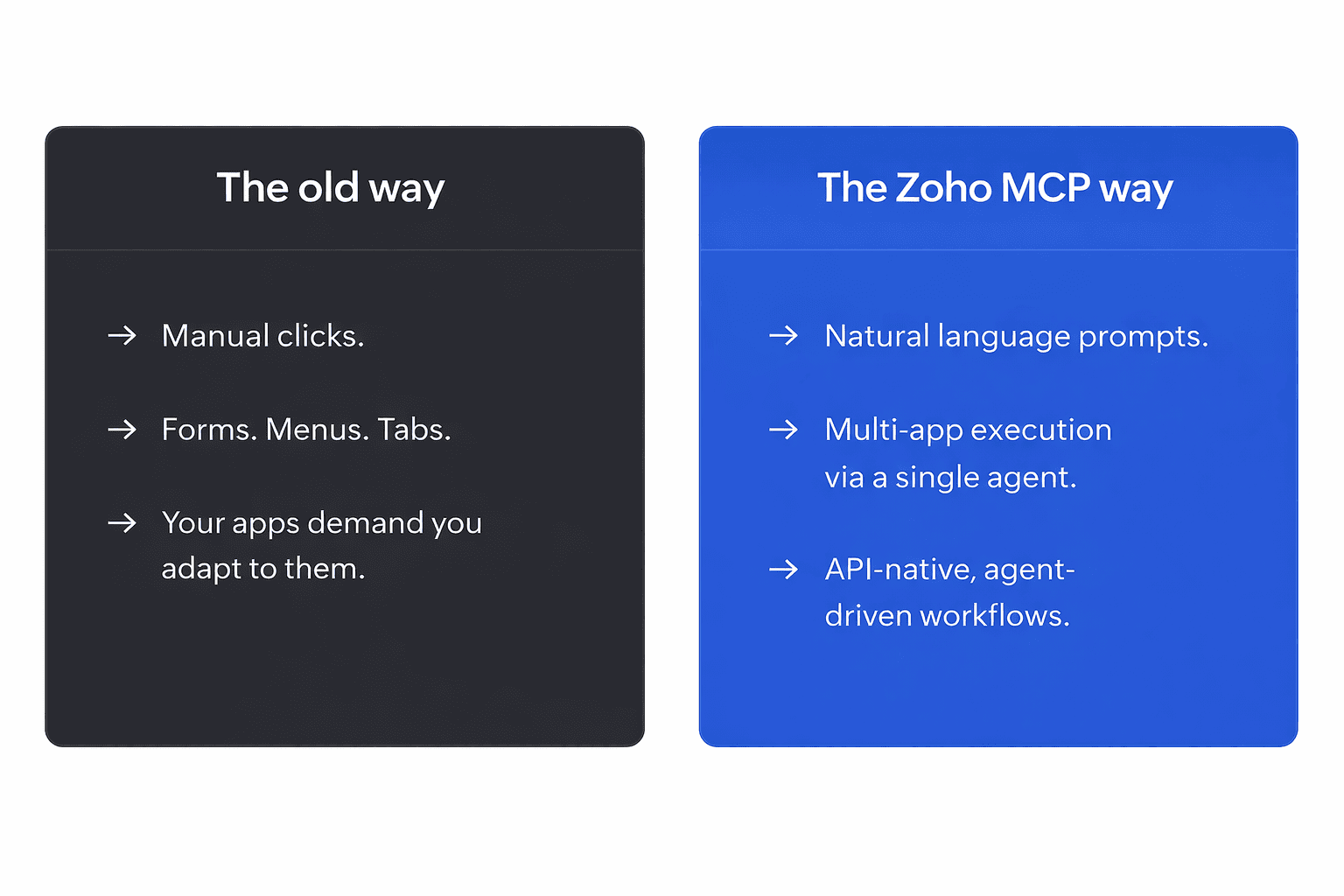
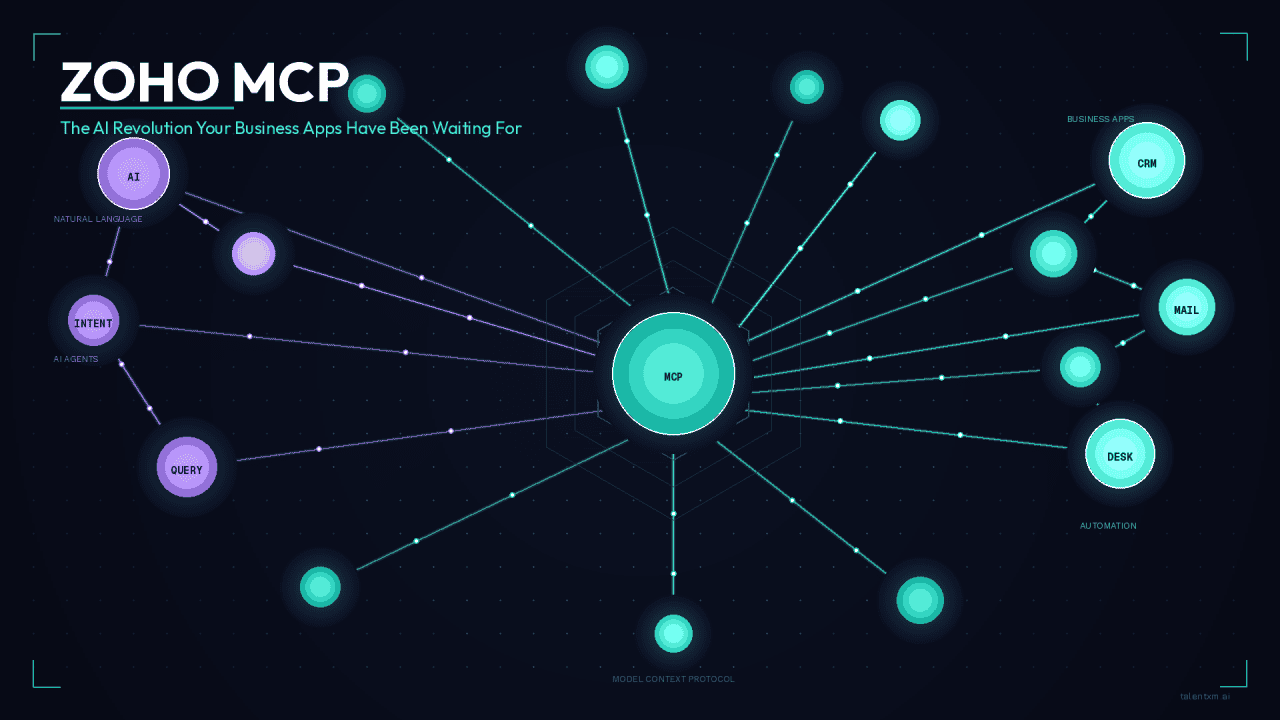
MCP (Model Context Protocol) is an application layer that enables artificial intelligence to communicate directly with your business systems. In the past, AI only provide recommendations. Now it can take action.
Instead of manually navigating through interfaces, filling out forms, and switching between applications, you simply describe a task in plain language, and an AI carries it out directly within your tools. Most importantly, this doesn’t require any technical expertise or a dedicated IT team.
Why This Matters for Small and Medium-Sized Businesses
According to the Harvard Business Review, the average employee switches between applications about 1,200 times a day. This amounts to nearly five full workweeks per year spent simply on context switching.
Founders and owners of small and medium-sized businesses—CEOs of service companies, leaders of consulting firms, and SaaS —feel this particularly acutely. CRM in one system, accounting data in another, and customer support data somewhere else. The data exists, but it’s scattered. AI exist as well, but most of them only analyze rather than take action.
The problem isn’t that businesses lack data. The problem is the disconnect between your systems and the decisions you make. That’s where time, money, and customer trust are lost.
How It Works in Practice
You don’t need to be a developer to understand the logic. Here’s a typical scenario:
You tell your AI :
“Client X has signed the contract. Mark the deal as won, generate an invoice, and schedule an onboarding call for next week.”
The AI translates that request into concrete actions across multiple systems: it marks the deal as won in your CRM, automatically schedules a call in your calendar, and generates an invoice in Zoho Books. All of this happens without a single manual step.
The key advantage is shared context. The AI that “Client X” in the CRM “Client X” with an outstanding invoice in Books are the same person. MCP provides a common protocol for tools to exchange data, enabling the AI to assemble a unified view of each customer without the need for manual spreadsheets or data reconciliation.
Practical Use Cases: SaaS, Service Businesses, and Consulting
SaaS
A common challenge in SaaS tracking customers through various stages, such as trials, onboarding, and renewals.
With Zoho MCP, you can set up an AI that can:
automatically convert leads into contacts, create follow-up tasks, and update CRM with a single prompt
notify you when customer subscriptions are about to expire and instantly generate a personalized renewal email
Generate a daily summary each morning showing new signups, active trials, and support tickets that have been open for more than 24 hours
Service Businesses (Agencies, Studios, Outsourcing)
In service-based businesses, the biggest challenge is often tracking projects and issuing invoices on time.
An AI powered by Zoho MCP can:
generate client invoices and prepare financial summaries, automatically flagging overdue payments
When a project is closed, archive the tasks, send a final report to the client, and create a new project record for the next phase
monitor team workload and alert you when a specific team member becomes overloaded with tasks
Consulting Firms (Management, IT, & Strategy)
Consultants spend a disproportionate amount of time on administrative tasks—such as emails, scheduling, and documentation.
Implementing Zoho MCP can significantly reduce this overhead without requiring developers.
For example, after every meeting, the AI can automatically log meeting notes in the CRM, send a summary to the client, and schedule the next follow-up. With Zoho Analytics, you can also ask business questions in natural language and receive analytical reports without writing complex queries or formulas.
What About Security?
This is a natural concern for any founder or CEO.
Zoho MCP adheres to enterprise-grade security standards. Data access and AI are governed by strict permissions, encryption, and audit logs. An AI can only perform the actions you explicitly authorize.
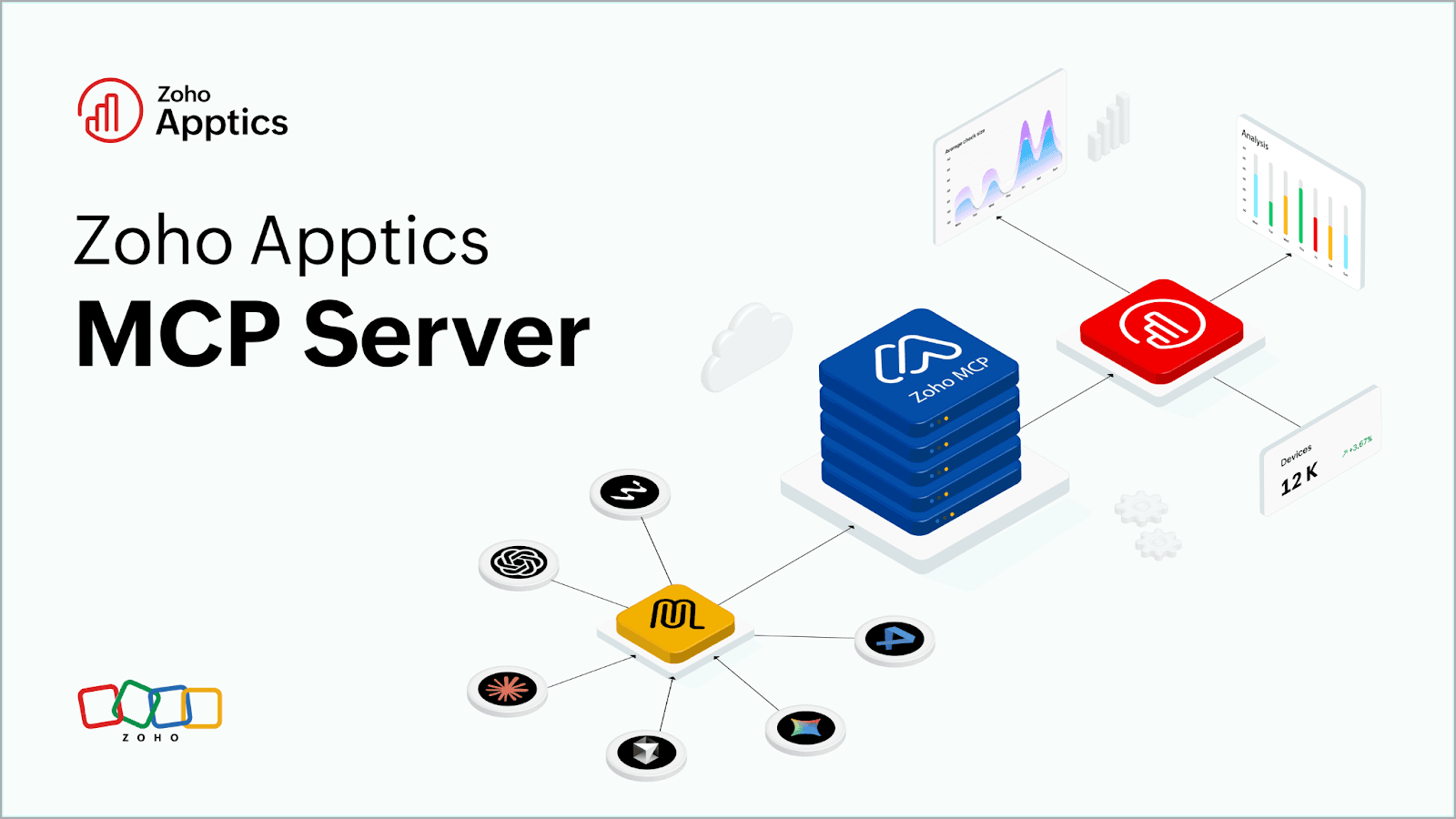
Another key advantage for small and medium-sized businesses is that Zoho MCP is not tied to a specific AI . This means you can use ChatGPT, Claude, or other AI while retaining the same integration capabilities.
Implementing Zoho MCP in Your Business
Zoho is currently offering early access to MCP servers, with general availability expected by the end of 2026. Pricing details are expected to be announced closer to the official launch.
This means one thing: now is the best time to understand the technology and prepare your business, before your competitors start adopting it.
Zoho MCP isn't just another chatbot or automation tool that requires complex configuration.
This marks a paradigm shift. AI evolving from a passive assistant to an active executor. Multi-step business processes can be completed instantly without manual intervention.
For founders and CEOs of small and medium-sized companies, this means less administrative work, fewer human errors, and more time to focus on what truly matters—customers, product, and growth. And all of this without the need for an in-house technical team.