Zoho CRM Review: The Best CRM for Sales Growth and Automation
What Is Zoho CRM Who Is It For?
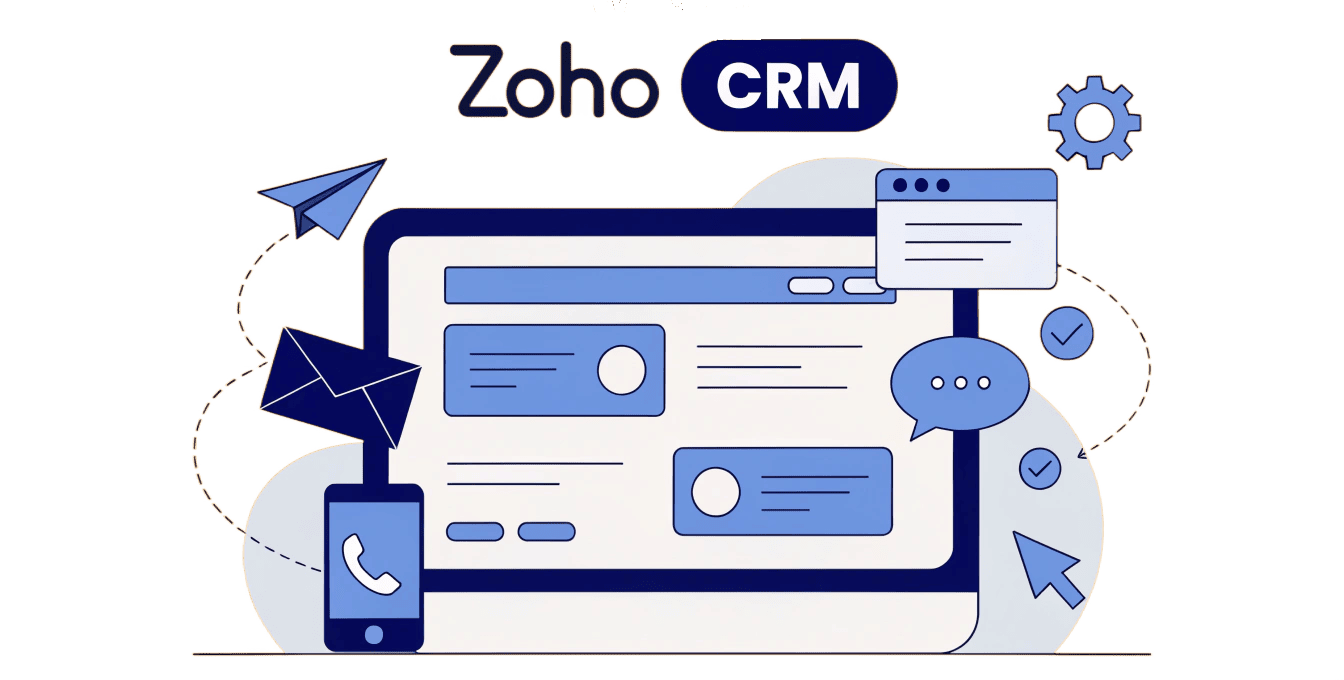
Zoho CRM a cloud-based CRM developed by Zoho Corporation, serving over 250,000 businesses worldwide. It’s not just a contact database—it’s a full-stack sales operating system featuring automation, analytics, AI, and integrations with dozens of third-party services.
Who Zoho CRM designed for:
Small and medium-sized businesses (5–200 employees) that need robust functionality without the high cost of enterprise-level solutions
SaaS with long sales cycles where pipeline visibility and lead scoring are critical
B2B —digital, consulting, and PR—manage client relationships from initial contact through renewal
E-commerce with a B2B where sales are driven by account managers, not just the online store
Sales teams of 10 or more where process standardization and pipeline management are essential
Who it's not a good fit for — we'll be honest about that at the end. But let's be clear from the start: if your business requires extensive customization or a highly specialized vertical workflow, expect significant setup costs regardless of which plan you choose.
Learn more atto find out which CRMs are suitable for businesses of different sizes
Zoho CRM in 2026
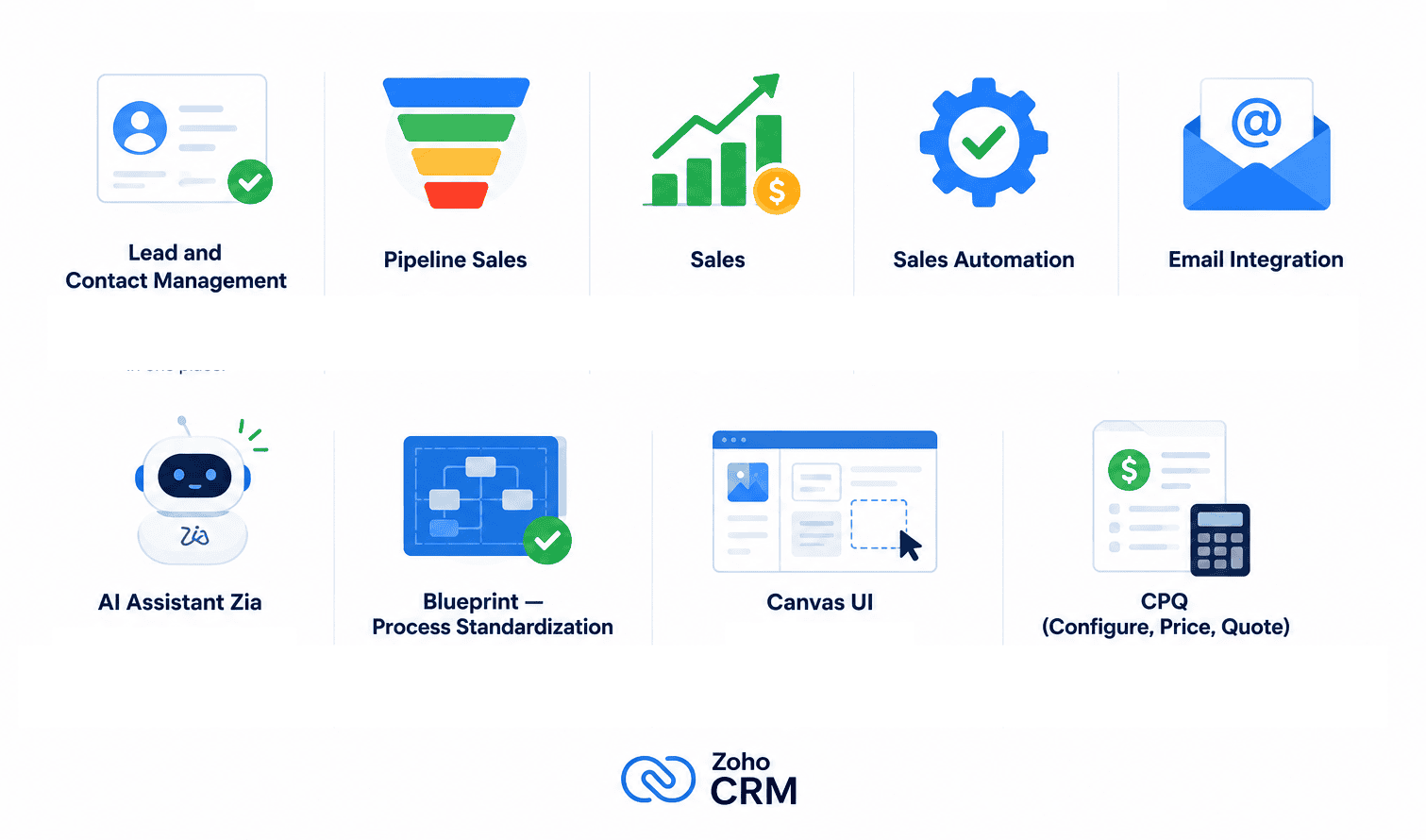
Lead and Contact Management
Zoho CRM leads from web forms, email, social media, phone calls, and manual entry. Every lead has a complete timeline of all interactions—from the first email to the signed contract. Duplicates are automatically detected and merged.
Sales Pipeline
The sales pipeline is fully customizable: you can run multiple parallel pipelines for different products, markets, or customer segments. Drag-and-drop management, color-coded deal priority, and automatic alerts when a deal remains inactive for too long—all of these features are available even on the basic plans.
Sales Automation
Workflows are where Zoho CRM shines. You can automate:
Emails triggered by changes in the deal stage
Lead assignment rules based on source, geographic location, or score
Create a task after every logged call
The field is updated when the conditions are met
Alerts for deals that haven't changed in N days
Email Integration
Two-way sync with Gmail, Outlook, and Zoho Mail. Emails are automatically linked to the relevant contacts and deals. Templates, bulk email campaigns, and open and click tracking—all in one place without the need for a separate marketing tool.
AI Zia
Zia Zoho's built-in AI , and by 2026 it will be far more capable than a basic search bar. Lead scoring, deal outcome prediction, next-step recommendations, email sentiment analysis, and the best time to contact—all included in the Enterprise and Ultimate plans at no extra cost. Learn more about Zia the dedicated section below.
Blueprint — Process Standardization
Blueprint is one of the most underrated features in the Zoho CRM . It’s a visual business process builder: you literally map out your sales process, define which steps are mandatory, who is responsible for each stage, and what data must be entered before a deal can move forward. It’s essential for teams where reps “forget” to send proposals or skip qualification steps entirely.
Canvas UI
A truly unique feature in this price range: a no-code, drag-and-drop studio for customizing record layouts. Instead of being limited to Zoho’s default field layout, you can redesign contact and deal cards to display exactly what your team needs—nothing more, nothing less. No developer required.
CPQ (Configure, Price, Quote)
Built for teams selling complex or configurable products. Automated proposal generation with custom pricing rules, discount logic, and product bundles. In Q1 2026, Zoho updated CPQ with Zia —the AI analyzes historical quotes and suggests the most effective product combinations at the time of quoting.
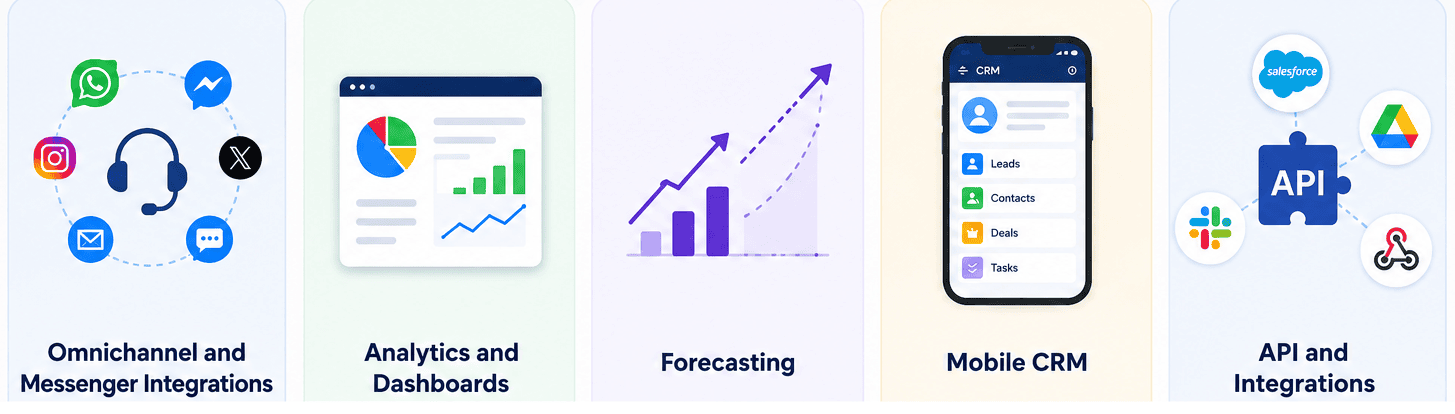
Omnichannel and Messenger
Zoho CRM communication via:
Email and telephony (built-in or via integration)
WhatsApp Business API
Telegram via integration or Zoho SalesIQ)
LinkedIn Navigator
SMS live chat
One important caveat: While the native WhatsApp app is available, full-scale use typically requires a paid WhatsApp Business API (such asTwilio or 360dialog)—this is an additional cost not included in the CRM .
Analytics and Dashboards
Reporting in Zoho CRM significantly more powerful than most competitors in the same price range. Custom reports, cohort analysis, funnel visualization, and anomaly detection are all available. The Ultimate plan unlocks Zoho Analytics, a full-featured BI layer that can connect to external data sources.
Forecasting
Sales forecasting takes into account deal probabilities, Zia AI , and seasonal trends—providing managers with a realistic revenue outlook than just a raw total of open opportunities.
Mobile CRM
Full-featured iOS Android apps: location check-ins for field sales, offline mode, voice notes, and business card scanning via camera.
API Integrations
A well-documented REST API. Native integrations with Google Workspace, Microsoft 365, Slack, Mailchimp, Zapier, Stripe, and hundreds of others. The Zoho Marketplace offers a wide selection of pre-built extensions, though the quality varies significantly depending on the publisher.
Complete Zoho CRM Table for 2026
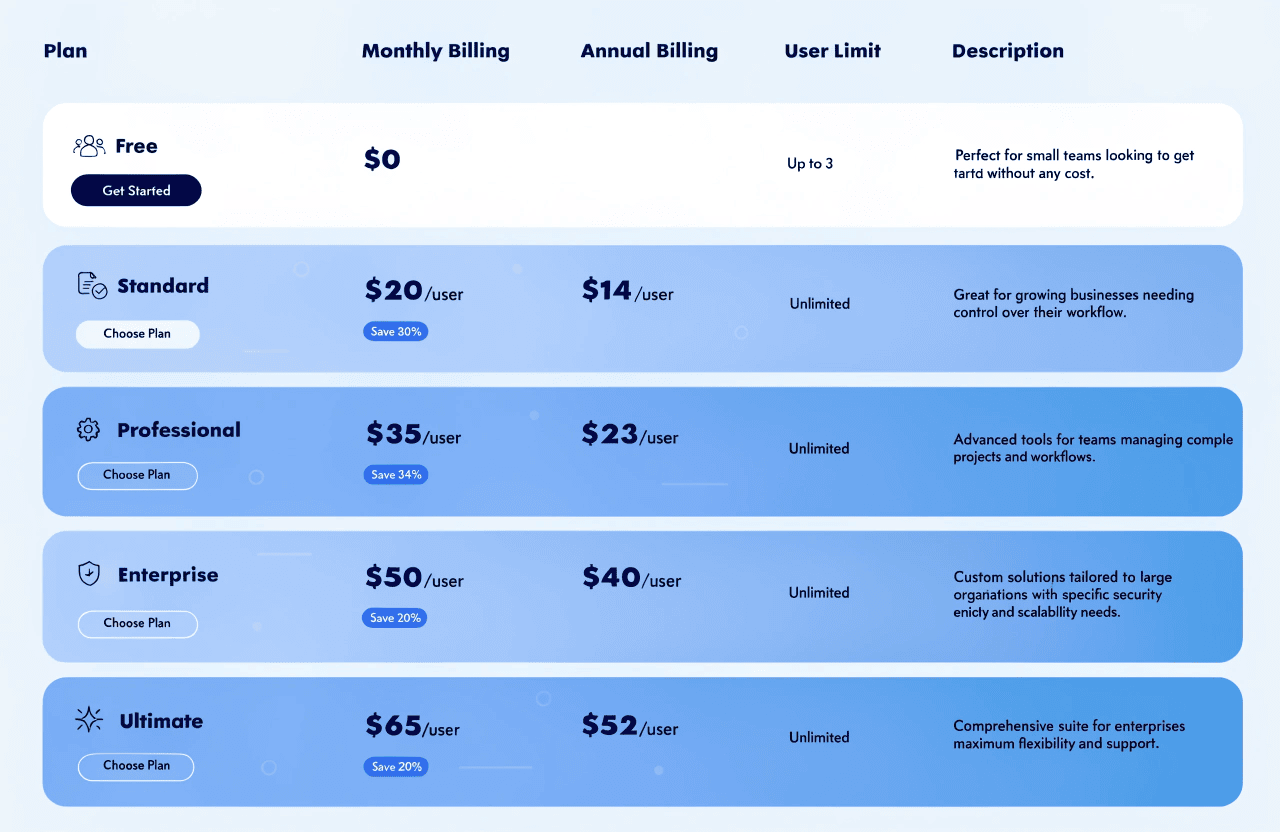
What Zoho CRM Costs: Real-World Business Scenarios
Startup, 5 people
Plan: Professional ($23/user/month, annual)
Licenses: 5 × $23 × 12 = $1,380/year
Onboarding (self-managed): $0 + 2–3 weeks of setup time
Total for the first year: ~$1,400–$2,000
SMB, 20 employees
Plan: Professional or Enterprise
Professional: 20 × $23 × 12 = $5,520/year
Enterprise: 20 × $40 × 12 = $9,600/year
Implementation through a partner: $2,000–$4,000
Annual administrative and support services: $1,000–$2,000
Total for the first year (Professional): ~$8,500–$11,500
Total for the first year (Enterprise): ~$12,600–$15,600
Sales Team, 50 People
Plan: Enterprise ($40/user/month, annual)
Licenses: 50 × $40 × 12 = $24,000/year
Implementation: $5,000–$10,000
Integrations and ongoing customization: $2,000–$5,000 per year
Total for the first year: $31,000–$39,000
Strengths and Weaknesses
Deep automation at competitive prices — Professional offers unlimited workflow rules. Most competitors either limit the number of rules or restrict this functionality to higher-tier plans.
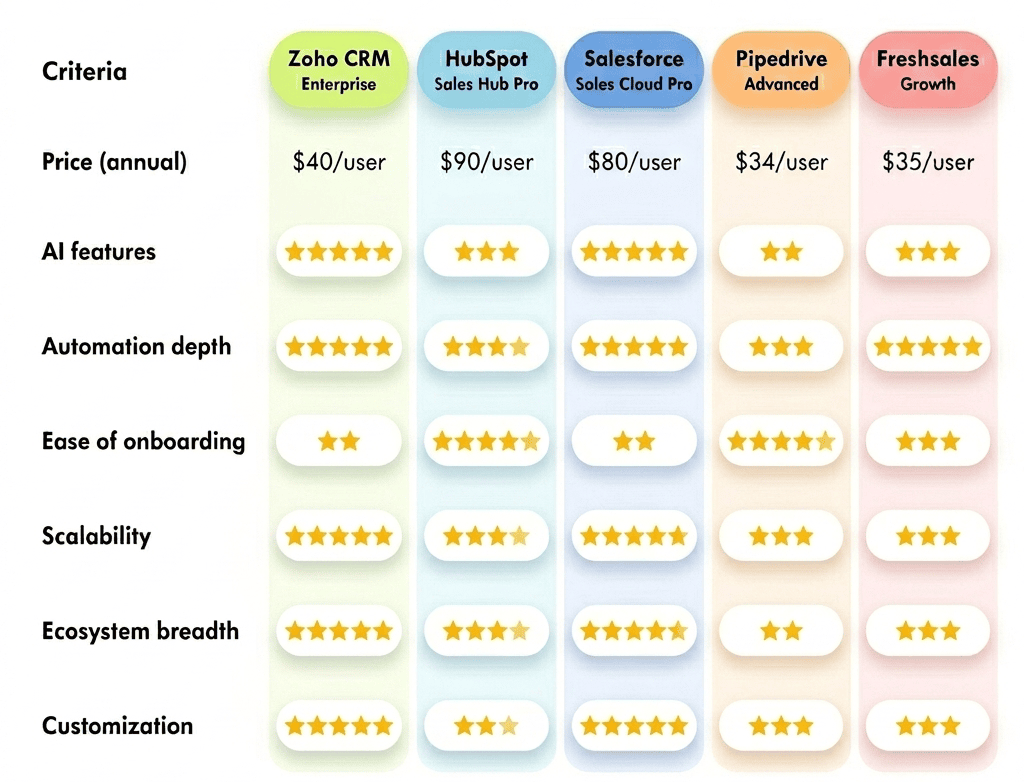
Significant savings compared to Salesforce The Enterprise plan at $40 per user offers comparable functionality to Salesforce Cloud Professional at $80 per user. Up to a 50% cost reduction with no significant loss of features for most use cases.
The Zoho ecosystem — over 50 natively integrated apps. No "Frankenstein stack" of ten disconnected SaaS , each with its own data model and API .
AI a separate license — Zia included in the Enterprise and Ultimate plans. Compare this to Salesforce or HubSpot , which are sold as add-ons on top of the base plans.
Blueprint is a process standardization tool with no real equivalent at this price point. If your sales process includes mandatory steps that reps tend to skip, Blueprint is the solution.
Canvas UI in-depth interface customization without needing a developer.
True scalability—a single platform that can scale from a 5-person startup to a 500-person enterprise without the need to switch platforms.
Onboarding complexity is consistently the top complaint in reviews across every major platform. CRM flexibility is real, but that flexibility means there are dozens of configuration decisions to make before the system becomes useful. Without a technically capable administrator or an external consultant, the first few weeks feel like a maze.
UI feels dated UI some areas—parts of the interface look like a product from 2015. Canvas UI this issue for record layouts, but only for teams that take the time to build the templates. Out of the box, the default experience can feel cluttered.
Zoho CRM Competitors 2026
The Real Cost of Zoho CRM: Hidden Expenses
Implementation & setup: Zoho CRM not plug-and-play. Expect 2–8 weeks of setup, and $1,500–$10,000 if you use a partner or consultant.
Team training: Sales teams require structured onboarding sessions. The typical cost ranges from $500 to $1,500, plus the time investment required from plus .
Integrations & add-ons: Basic integrations are free, but third-party tools (WhatsApp API, Zapier, marketing tools) cost approximately $20–$200+ per month, depending on usage.
Customization & development: Advanced setup (Blueprints, APIs, custom modules) often requires a developer at $30–$100 per hour, especially for complex workflows.
Support & ecosystem: Zoho's support can be slow on lower-tier plans, making Zoho One more cost-effective option for companies that use multiple apps.
Who Should Choose Zoho CRM 2026
Choose Zoho CRM :
Your sales team consists of between 5 and 150 people
You sell B2B a complex or multi-stage sales cycle
Process standardization matters to you (Blueprint is a true differentiator)
You want AI without paying Salesforce
If you plan to use multiple Zoho products— CRM Books, Desk, and Projects— Zoho One a smart financial choice
Your budget is limited, but your functional requirements are not
You have or can secure the technical resources needed for proper implementation
Industries where Zoho CRM particularly well: SaaS , IT services, consulting, real estate, financial services, and manufacturing with B2B teams.
Get More Value Zoho CRM
But the key isn't just buying a license. The key is implementing the system correctly.
That's where the CRMOZ helps you get the most out of Zoho CRM:
Set up your sales funnels
automate processes and Blueprints
integrate email, phone systems, instant messaging apps, and APIs
Set up AI Zia, Canvas UI, and analytics
provide team onboarding and ongoing support